
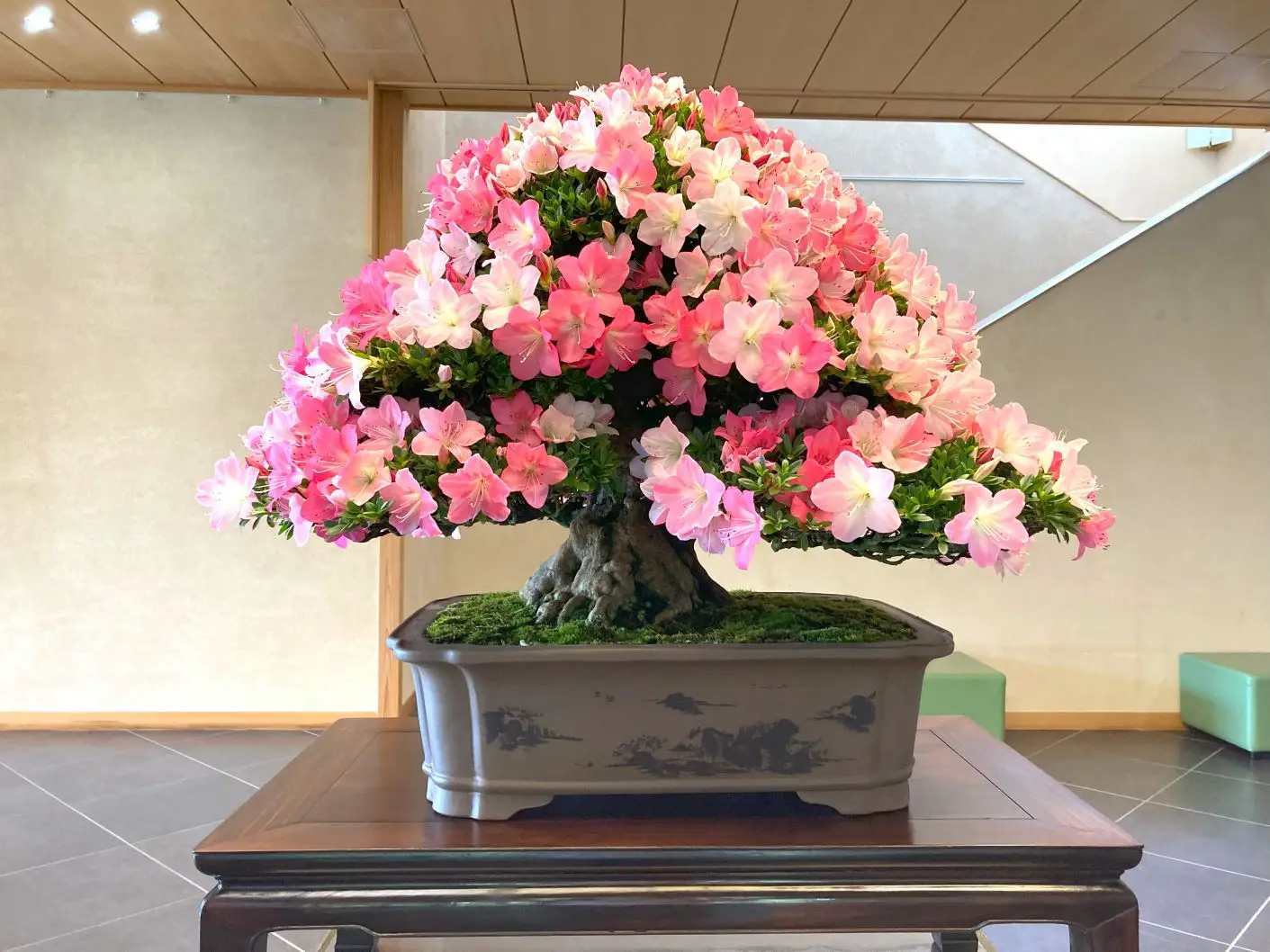
Azalea bonsai care
Azalea bonsai care at a glance
| Cold tolerance | Strong |
| Heat tolerance | Strong |
| Drought tolerance | Fairly strong |
| Sun exposure | Full sun |
| Soil mix | Kanuma soil: 100% |
| Watering | 1-2 /day in spring and fall 2-3 times/day in summer Once every 3-4 days in winter |
Choosing the right azalea variety

Azalea bonsai
When selecting an azalea variety for your bonsai project, consider species with the following characteristics. It will make a perfect azalea bonsai for you.
-
- Beautiful flowers
- Abundant flowering
- Compact growth habit
- Small leaf size
- Fine and dense foliage
- Thick trunks
Based on these preferred characteristics, the following species/varieties are commonly grown as azalea bonsai:
- Satsuki azalea (Rhododendron indicum)
- Miyama Kirishima Azalea (Rhododendron kiusianum var. kiusianum)
- Kurume azaleas
- Yama Tsutsuji or torch azalea (Rhododendron kaempferi)
For more about azaleas in general and the best one for bonsai, the following article may be helpful.
Placing

Outdoor placement
Sunlight requirement
Selecting the appropriate location for your Azalea bonsai is a key factor in its overall well-being.
Choose a place where your azalea bonsai can get at least 5 hours of direct sunlight per day. It is true that azaleas are quite resilient and can tolerate in shades but they do need sufficient sunlight for a proper flower bud formation.
Sunlight is important especially before and during summer for the branches and leaves to achieve their full potential which leads to abundant flowering. They need to accumulate enough carbohydrates produced by the leaves through photosynthesis during this crucial period.
While they can be exposed to direct sunlight all year, provide shade from the afternoon sun during a heatwave. They may survive the heat but the flower buds may not develop well under the high temperature.
Airflow
You should place your azalea bonsai where there is enough airflow as well. Airflow helps photosynthesis by providing fresh carbon dioxide and oxygen continuously. It also prevents pests and diseases, especially during summer when humidity can accumulate inside the foliage.
Indoor placement
I wouldn’t recommend placing your azalea bonsai indoors if you want to see abundant flowering. Your bonsai may thrive quite well indoors but indoor indirect light may not be enough in terms of intensity and hours of light they have to receive for flower bud formation.
But if you do want it indoors, the only option for indoor placement is to place them at and NOT NEAR the south or east-facing windows where your azalea bonsai receives at least 5 hours of sunlight.
Watering

As a general guide, azalea bonsai should be watered;
- Once to twice/day in spring and fall
- Twice or three times/day in summer
- Once every 3 to 4 days in winter
Azalea bonsai loves water and prefers a moist to a dry environment. That said, always having too much water in the pot can lead to root rot. So, it is vital to give the right amount of water for your azalea bonsai to thrive.
Remember that the drying process depends on where you are, where you keep your bonsai as well as its species, size and age. So, make sure to water it when the soil is half dry before it is completely dried out.
In winter, even evergreen azaleas almost stop growing and they don’t require a lot of water. But your bonsai will die if the soil becomes completely dry. Make sure to water them adequately in winter as well.
Repotting

How often to repot
Your azalea bonsai needs to be repotted every 2 years when young and every 3 to 4 years when mature.
If the soil still drains well and loosens easily from the root ball, repotting can be delayed. Check the roots by touching the soil or looking from the pot hole before deciding.
When to repot
The best time to repot azalea bonsai is early spring, just before leaves open.
Traditionally, Satsuki azalea bonsai were repotted right after blooming (around April to May). This used to work well because summers were milder and trees had enough time to recover from root pruning before serious heat arrived.
However, in many regions today, especially with hotter summers, repotting right after flowering can weaken the tree before roots fully recover.
What is good when repotted in early spring
The tree has not fully awakened so, roots can be pruned more safely. And the entire spring and early summer are available for recovery. Stronger roots by autumn mean stronger growth and more flower buds for the following year.
Best soil mix for azalea bonsai
The best soil for azalea bonsai is;
- Kanuma soil: 100%
- Akadama/ lava rock: 60%
- Pumice: 30%
- Peat moss/ tree bark: 10%
Why Kanuma soil?
Kanuma soil is traditionally considered the best choice for Satsuki azalea and regular azalea bonsai. This is because its properties, like good water retention and aeration as well as being acidic, align with what azalea bonsai needs: azalea bonsai trees like a balance of moisture and aeration along with acidity.
If you are interested in knowing more about Kanuma soil, please check the article below.
Kanuma soil alternative
Akadama
Kanuma soil can be quite difficult to buy outside of Japan and you might be wondering if there are any alternatives for it. One of the very good alternatives for Kanuma soil is Akadama.

Akadama & Kanuma soil underground
Kanuma soil and Akadama are in many ways similar to each other, like good water retention, aeration and drainage, and are both well suited for azalea bonsai cultivation. This is because Kanuma soil and Akadama are found together in the same region, just in different layers; Kanuma soil is deposited just below the Akadama soil layer.
Volcanic rock/ pumice
Other good alternatives for Kanuma soil are volcanic rock and pumice. Kanuma soil is actually weathered volcanic pumice stone. As such, volcanic rock and pumice would make good substitutes for Kanuma soil.
One of the major differences between Kanuma soil and volcanic rock/pumice is its water retention. Kanuma soil can hold onto water much better than volcanic rock or pumice stones, making it a great choice for azalea bonsai.
So, adding a bit of peat moss or tree bark to increase water retention as well as acidity (this is from peat moss only) can be a good idea.
There are a few ready-to-use premixed bonsai soils in the market that can be used for growing azalea bonsai as well.
How to repot
Step 0
Before touching the tree:
- Attach pot mesh to drainage holes
- Prepare wires to secure the tree
- Mix your soil
Once roots are exposed, they dry quickly. Preparation prevents unnecessary stress.
Step 1
Gently remove the tree from the pot. If stuck, tap the pot a couple of times or run a root knife along the inner edge.
Check the root ball. If the soil falls away easily and roots look healthy, you may not need repotting yet.
Step 2
Start from the bottom of the root ball.
Loosen soil carefully. If the soil is extremely compacted, lightly tap the bottom with a wooden or rubber mallet to loosen it. If necessary, cut off about one-third of the bottom roots.
Work upward from the base outward, protecting surface roots.
- If soil is hardened and drainage has failed → remove all old soil.
- If soil loosens easily and roots are healthy → removing about two-thirds is sufficient.
Step 3
Wash roots to take off the old soil if:
- Soil is severely compacted
- You see black or rotting roots
- Drainage has clearly failed
Washing feels extreme but in these cases, it actually improves recovery.
If roots are white, fine and healthy, and soil is still soft, do not wash.
Step 4
Flatten the bottom of the root mass by removing about one-third of the lower roots. This prepares the tree for a shallow pot. Remove thick downward-growing roots.
Then, trim outer roots so the tree fits comfortably in the pot, leaving space for regrowth.
Be especially careful with fine hair-like roots. These delicate roots are responsible for nutrient uptake and flower bud production.
- If the tree is mature or weak, avoid aggressive pruning of fine roots.
- If the tree is young and vigorous, it can tolerate root pruning more easily.
Step 5
- Add a layer of coarse soil at the bottom for drainage.
- Create a small mound of soil mix.
- Place the tree and squeeze the roots into the soil well.
- Secure loosely first, adjust positioning, then tighten wires firmly.
Then, add soil gradually. Use a chopstick to work soil between roots and eliminate air pockets. Tap the pot gently to settle the soil.
If the pot is shallow and dries quickly, a thin ridge of sphagnum moss around the edge can help retain moisture.
After repotting, water well and move the tree to a shaded place with little wind for 1 to 2 weeks until it takes root. During this time, make sure not to let the soil dry out, and water it before it completely dries out.
Fertilizing
When to fertilize
Satsuki azalea and regular azalea needs fertilizer at different time of the year because of their differences in blooming season. So, it’s important to know what kind of azalea bonsai you have.
Satsuki azalea
Spring
Satsuki azalea sprouts before blooming in May.
Start fertilizing just before the new shoots come out in around March to help them grow. During the period of sprouting until blooming, Satsuki azalea needs a lot of nutrients for the roots, branches, and leaves to grow.
Stop fertilizing sometime before blooming so that all the nutrients in the soil are absorbed by the tree at the time when the flowers bloom. Check the label of the fertilizer you are using and see how long it takes for a tree to absorb nutrients.
Start fertilizing again after blooming. Your trees use up a lot of nutrients in their body for flowering and fertilizer will make them strong again.
Do not give nitrogen-rich fertilizer at this time. Your tree will prioritize leaf growth over flower bud growth if abundant nitrogen is present. Make sure no excess nitrogen remains in the soil at the time of flower bud formation until summer.
Summer
Stop fertilizing during summer as your bonsai doesn’t absorb as much nutrients when it is hot.
Fall
Start fertilizing again from late August until October. During autumn, the trunk and branches get thicker instead of getting longer. Apply fertilizer until about October to help it grow and be healthy in winter.
Winter
You don’t need to fertilize during winter as your bonsai isn’t growing much.
Regular azalea
Spring
Regular azaleas sprout after they bloom.
Start fertilizing in (very) early spring and then stop to avoid having any fertilizer left in the soil while they are flowering.
It’s crucial that there are no leftover nutrients in the soil when the blooming happens from April to May. If there’s still fertilizer in the soil during flowering, the tree might focus on growing leaves and branches instead of blooming.
Start fertilizing again after flowering.
Summer
Stop fertilizing during summer as your bonsai doesn’t absorb as much nutrients when it is hot.
Fall
Start fertilizing again from late August until October. During autumn, the trunk and branches get thicker instead of getting longer. Apply fertilizer until about October to help it grow and be healthy in winter.
Winter
You don’t need to fertilize during winter as your bonsai isn’t growing much.
Which fertilizer to use
Choose a fertilizer with a higher middle and last number in the N-P-K ratio, indicating a significant phosphorus and potassium content. The following product from Amazon is a slow-release bonsai bloom fertilizer with an N-P-K ratio of 6-8-10 and is perfect for your azalea bonsai.
You can also choose a balanced bonsai fertilizer that will give ideal growth for all bonsai trees including azalea bonsai trees. (N-P-K ratio is 12-11-10 for the following product.)
Styling

Deadheading
After blooming, remove each spent flower one by one (this process is called “deadheading”). This is to encourage focusing the tree’s energy on producing new flower buds.
Pinching
If you want more ramifications and to enhance tree size, pinching new azalea bonsai buds should be done just after blooming and no later than June as azaleas create flower buds in early summer. If it is done later than this, the flower buds for the next season won’t grow properly (or not at all).
Azalea sprouts 4 to 5 buds from one spot. Choose two that are NOT too strong and have a good direction of growth, and cut the rest. Then, leave 2-3 leaves on this branch and pinch the rest.
Around 10 days after pinching, a second flush of new buds will start to grow. If these second buds are too strong and it is before mid-July, pinch new buds in the same way as the first time.
Pruning
Pruning for styling and shaping younger azalea bonsai trees should take place during early spring before the flowers bloom.
Early spring pruning is also appropriate when you want to reduce the size of a tree or when you want to alter the tree’s overall shape. This offers the benefit of quick styling of the tree shape, while unfortunately, it prevents it from blooming this year.
If your tree is mature and you want to keep the tree size, on the other hand, prune all the new shoots after blooming and before summer. Cut off other leaves leaving 2-3 leaves. After about a month, new buds will start to grow. You can control the tree’s shape and size by keeping 2-3 buds that are growing in a good direction.
Wiring
The best time of the year to wire your azalea bonsai is in early spring, just before the buds start to appear.
Wiring at this time when the new buds are about to come out, the tree will bounce back quickly, even if you push a bit harder, and you’ll likely achieve the desired tree shape within a year. Keep in mind that its bark can be easily peeled off and damaged since the tree is actively growing.
Wiring in fall is possible, but the branches and trunks become tougher and more resistant to bending. Also, winter arrives before your trees fully recover from the stress of being wired, making it challenging to bend them hard into desired positions.
Wires should be removed after 3 to 4 months for younger trees and a year for mature trees, before they start to eat in the bark.
Blooming care

Satsuki azalea
To ensure your azalea bonsai produces abundant and vibrant flowers, it’s important to provide the right care and attention.
-
- Place outside under full sun at least 5+ hours a day
- Maintain a moderate temperature range: Between 59°F to 68°F (15°C to 20°C) is best for flower bud development.
- Give the right fertilizer: Emphasize phosphorous and potassium and less nitrogen.
- Prune just after blooming: Flower buds start to emerge soon after blooming.
- Provide adequate watering: Avoid water shortage or overwatering.
For more detailed information about blooming azalea bonsai, I wrote the following article about it which might be helpful.
Defending against infestation

Prevention
Protecting your azalea bonsai from pests and diseases is essential to maintaining its health and vitality. For this, prevention is the key; it is way easier than treating or eradicating pests/diseases once they occur.
Check and monitor your trees regularly. Make sure to look at them from all directions. Provide them with the optimal location and environment. And when acquiring new trees, quarantine them for a period to prevent introducing pests or diseases to your other bonsai trees.
Common azalea bonsai pests
Common azalea pests include azalea caterpillars, azalea leafminers, scale insects, aphids and mites. Azalea caterpillar and azalea leafminer are the insects that infest azalea bonsai particularly, which can reduce their ability to produce flowers.
How to treat azalea bonsai pests
Here are 3 steps to get rid of bugs on your azalea bonsai trees:
-
- Identify bugs
- Use non-chemical option
- Use chemical option
Identify bugs
Familiarize yourself with the common pests that affect azalea bonsai trees in your area. This will help you identify any pests you may encounter.
Non-chemical options
Before using chemicals, there are non-chemical options you can take, including taking them out by hand and pruning affected areas, to get rid of bugs on your bonsai trees. These are easy to do and do no harm to your bonsai trees.
Chemical options
As a chemical option, I would recommend using neem oil for eradicating pests. Neem is a tree native to the Indian subcontinent, which acts as an insect repellent and growth inhibitor. Neem oil is safe for plants as well as humans and works perfectly for my bonsai trees.
Common azalea bonsai diseases
Common azalea diseases include dieback, powdery mildew, and blight.
How to treat azalea bonsai diseases
Here are 3 steps to treat diseases on bonsai trees.
-
- Identify the disease
- Use non-chemical options
- Use chemical options
Identify the disease
Look for the symptoms of the tree and do research on azalea bonsai diseases. Common symptoms include discoloration of leaves, wilting, deformation, cankers, or abnormal growth.
Use non-chemical options
Remove the infested parts carefully using a sterile tool. This may include leaves, branches, or even a part of the trunk if the disease has progressed too far. Do not use your hands because you may touch other trees later, risking the disease to spread.
Use chemical options
Neem oil has antifungal and antibacterial properties that can help control certain bonsai diseases.
If neem oil does not work, identify the problem and choose the right product that can treat the disease. There are many different types of fungicides and bactericides available in the market but not all of them work for the problem with your bonsai.
If you are interested in preventing or treating pests and diseases, please read the following article. It is a complete guide that can help you.
Caring in extreme weather

Azaleas are in general pretty tough in extreme temperature, hot or cold.
Even if the temperature goes down to around 14°F (-10°C) and the soil in the pot freezes, azalea bonsai usually won’t die unless they’re getting enough sunlight and water. Make sure they are in a sunny spot that is not too windy or dry, if you live in a region where the temperature doesn’t go lower than 14°F (-10°C).
If it gets colder than 14°F (-10°C) or if you’re in a snowy area, you’ll need to protect them from the cold. You can do this by taking them into a shed, building some kind of fence around them or covering them up with a cover.
During heatwave, provide shade from the afternoon sun. They may survive the heat but the flower buds may not develop well under the high temperature.